
How Dubai's 5% Escrow Retention Protects You After Handover

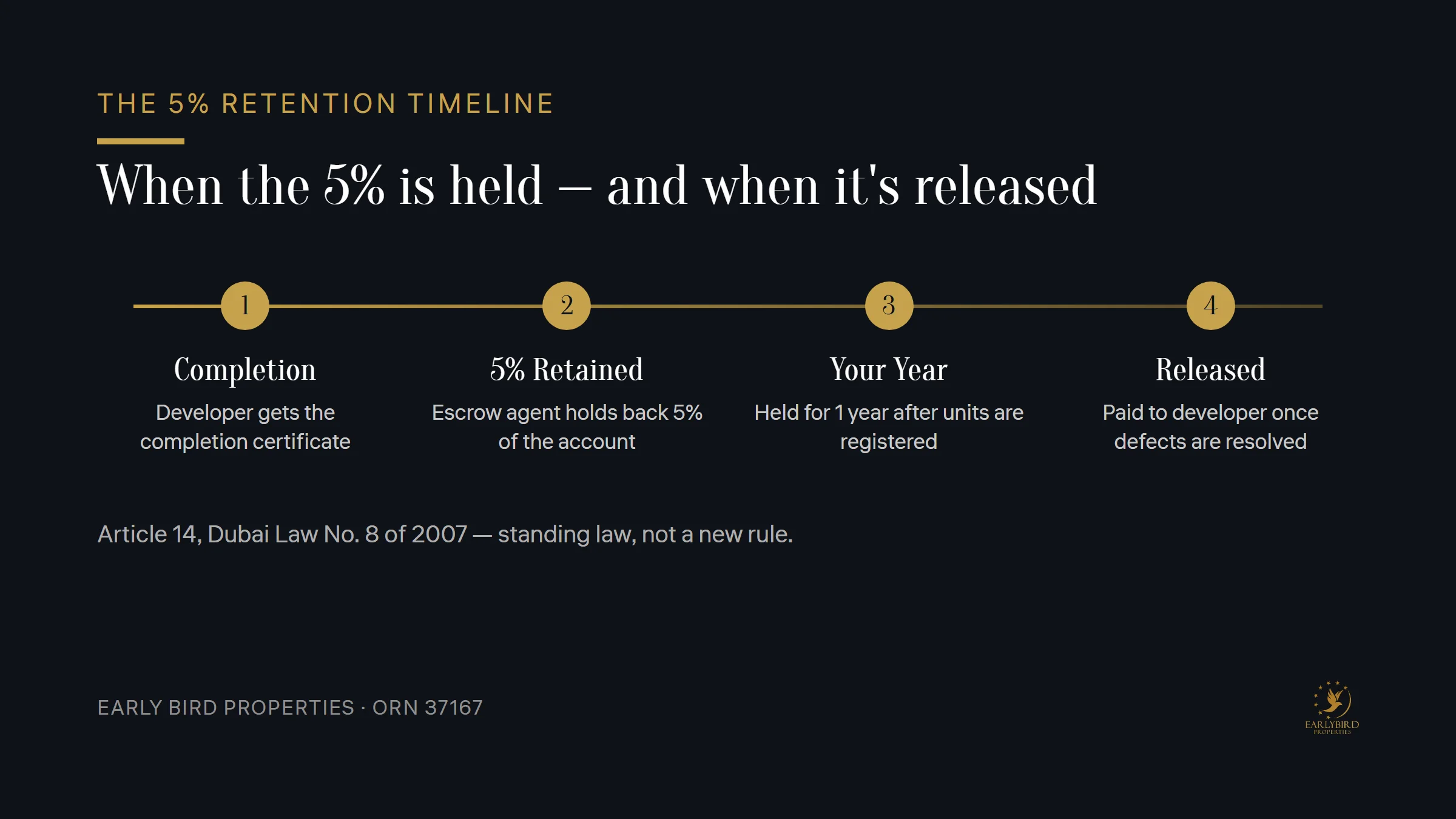
Under Article 14 of Dubai Law No. (8) of 2007 on real estate escrow accounts, the escrow agent must retain 5 percent of the escrow account's total value once the developer obtains the completion certificate — and that 5 percent is only released to the developer one year after the units are registered in the buyers' names. In plain terms: even after you get your keys, 5 percent of the money stays locked for a full year as a guarantee that the developer fixes defects that appear after handover. This is standing Dubai law, in force since 2007 — not a new rule — and this is Early Bird Properties' plain-English explainer of how that protection actually works for you as a buyer.
This is an explainer of existing law, written for first-time and overseas buyers who have never handed over a Dubai property before. Every rule below is quoted from the escrow law or the RERA framework, not from opinion. Where 2026 has changed anything, it is the enforcement — not the 5 percent figure, which is nineteen years old.
What is the 5% escrow retention?
Handover day — but 5% of the developer's money stays locked for a year
The 5 percent escrow retention is a rule that keeps part of a developer's money locked away after your building is finished. Article 14 of Dubai's escrow law requires the escrow agent to hold back 5 percent of the total value of the escrow account once the developer receives the completion certificate. The developer does not get that 5 percent immediately — it is released only one year after the units are registered in the buyers' names.
Think of it as a retention deposit, the same idea a homeowner uses when they hold back part of a builder's final payment until they are sure the work is sound. The purpose is written into the law: the retained amount is a guarantee that the developer or contractor promptly and effectively fixes defects that are clear at completion, or that appear within one year after handover.
How does the escrow account work before handover?
How escrow sits between your payment and the developer
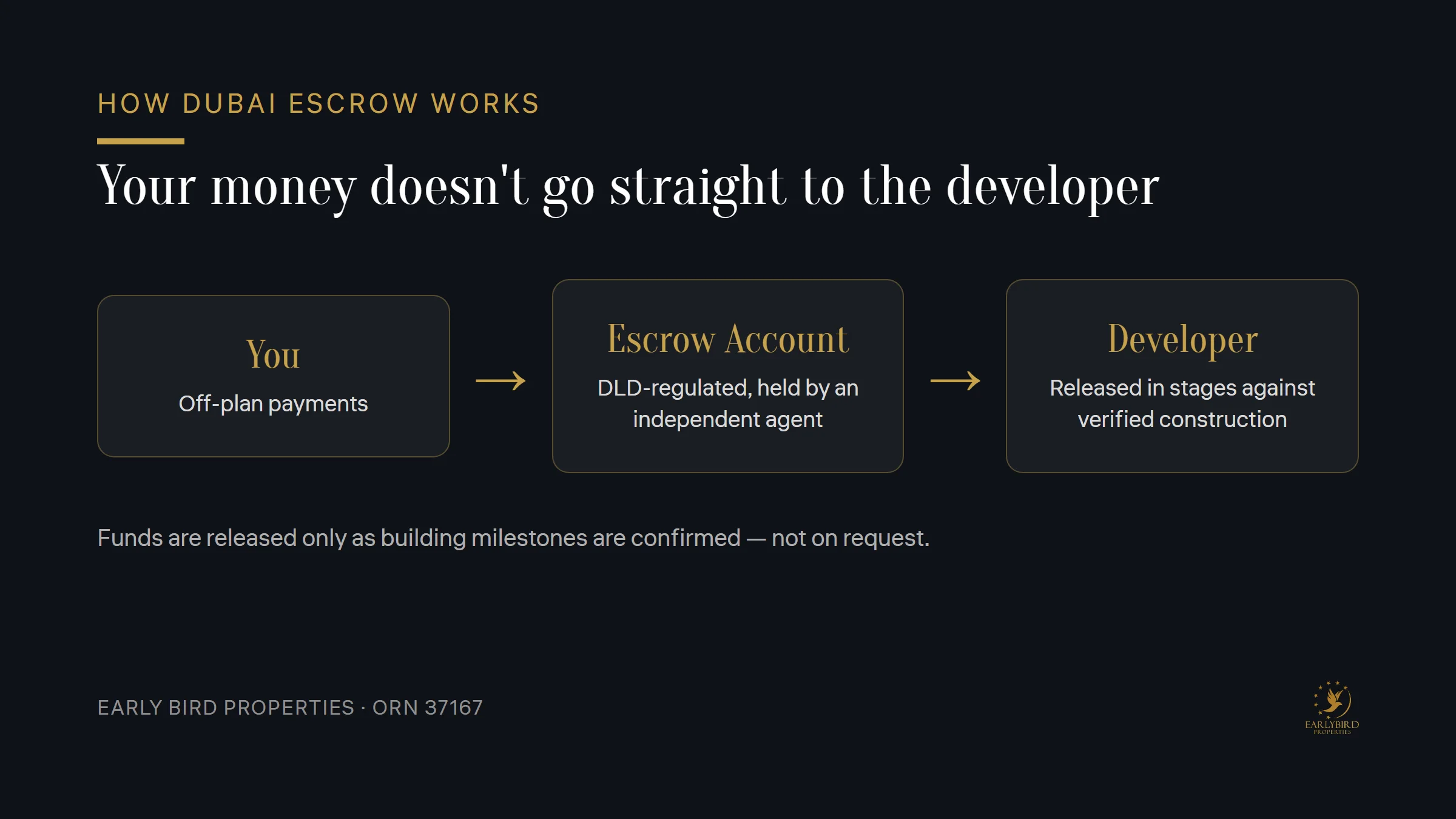
To understand the retention, you first need to understand the escrow account it sits inside. When you buy an off-plan property in Dubai, your payments do not go straight to the developer. By law they go into a dedicated, DLD-regulated escrow account controlled by an independent escrow agent — a bank or financial institution approved to hold those funds.
The developer cannot simply withdraw your money. Funds are released to the developer in stages, tied to verified construction progress — the deeper protection that off-plan buyers rely on. If you want the full picture of what can still go wrong and how to check a developer before you sign, we cover it in Dubai off-plan risks: what agents won't tell you.
What happens to the 5% after you get your keys?
Funds release against verified construction milestones, not on request
This is the part most buyers do not know. Completion and handover are not the end of the developer's obligations. Once the completion certificate is issued, the escrow agent retains 5 percent of the account's total value. That money stays locked for one year from the date your unit is registered in your name.
During that year, if genuine defects appear in the property, the retention is there to make sure they get fixed. The financial pressure is deliberate: a developer who wants their final 5 percent released has a direct incentive to resolve post-handover snags and defects rather than collect the money and walk away. Only after the year passes, with obligations met, is the 5 percent released to the developer.
What defects does this actually cover?
The 5 percent retention runs for one year, but the developer's responsibility for defects is layered — and the two most important periods are worth knowing before you buy:
| Type of defect | Liability period | What it means for you |
|---|---|---|
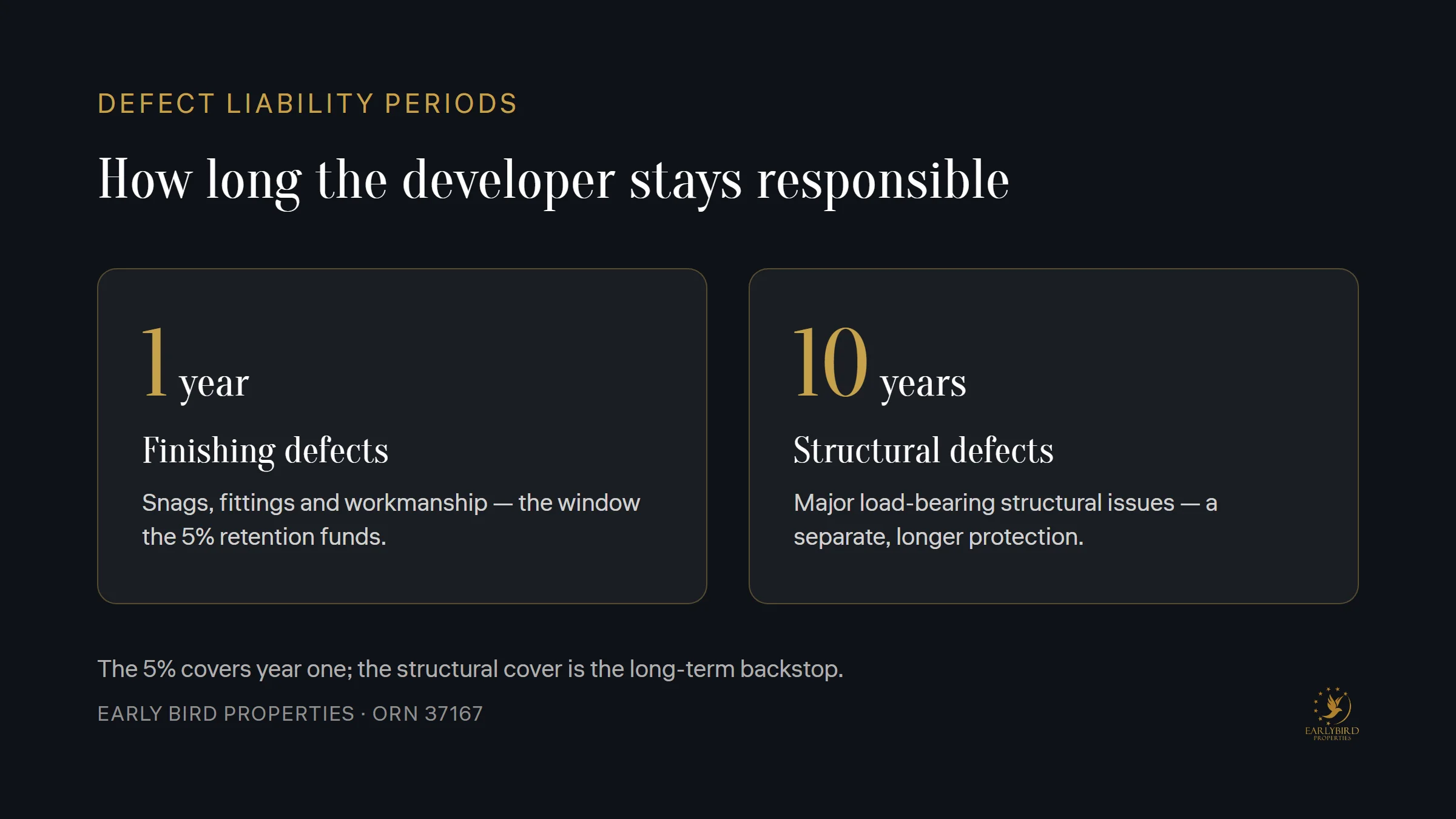
| Finishing defects | 1 year | Snags, fittings, workmanship issues that appear in the first year after handover |
| Structural defects (load-bearing) | 10 years | Major structural problems affecting the building's core structure |
The 5 percent escrow retention lines up with the one-year finishing-defect window — it is the funded safety net for exactly that first year of occupancy, when most snags surface. The ten-year structural liability is a separate, longer protection under the regulatory framework: even after the retention is released, the developer remains responsible for major structural defects for a full decade. For most buyers, the retention matters most in year one; the structural cover is the long-term backstop.
Is the 5% escrow retention a new 2026 rule?
No — and this is worth being clear about, because it is often described as new. The 5 percent retention is Article 14 of Law No. (8) of 2007. It has been part of Dubai's escrow framework for nineteen years. If you buy an off-plan property today, this protection already applies to you; you do not need to wait for a new law.
What has changed heading into 2026 is enforcement, not the figure. The Dubai Land Department and RERA have tightened oversight of escrow accounts — developer access to buyer funds is being tied more strictly to verified construction milestones, and compliance is being watched more closely. So the protection on paper since 2007 is being applied more firmly in practice. For the wider market picture around this tighter regime, see our Dubai real estate market report for Q2 2026.
What this means for you as a buyer
For an overseas or first-time buyer, the practical takeaways are simple. First, your off-plan payments are legally protected in a regulated escrow account, not handed to the developer to spend freely. Second, the protection does not stop at handover — 5 percent stays retained for a year specifically so post-handover defects get fixed. Third, you have a documented one-year window to raise finishing defects and a ten-year window for structural ones.
None of this replaces doing your own checks. Confirm the project is registered with RERA and the escrow account is in place before you pay anything, keep your completion and registration dates on record so you know when your one-year defect window runs, and document any defects in writing during that first year. If you are still weighing off-plan against a ready property, our comparison of off-plan versus resale in Dubai lays out the trade-offs.
Buying off-plan and want the protections explained before you sign? Talk it through — free, no pitch
Frequently Asked Questions
What is the 5% escrow retention in Dubai?
The 5 percent escrow retention is a rule under Article 14 of Dubai Law No. 8 of 2007. The escrow agent holds back 5 percent of the escrow account's total value once the developer gets the completion certificate. It is released only one year after units are registered to buyers, guaranteeing the developer fixes post-handover defects.
How long is the 5% held after handover?
The retained 5 percent is held for one year from the date the units are registered in the buyers' names. During that year it acts as a financial guarantee that the developer resolves defects appearing after handover. Only once that year passes, with defect obligations met, is the 5 percent released to the developer.
Is the 5% escrow retention a new rule for 2026?
No. The 5 percent retention is Article 14 of Law No. 8 of 2007 and has applied for nineteen years. What changed heading into 2026 is tighter DLD and RERA enforcement of escrow rules and milestone-based fund release, not the retention figure itself. The protection already applies to any off-plan purchase today.
What defects does the escrow retention cover?
The retention supports the one-year finishing-defect period after handover — snags, fittings and workmanship issues. Separately, the regulatory framework holds developers liable for major structural defects affecting load-bearing elements for ten years. The 5 percent is the funded safety net for the first year; the ten-year structural cover is a longer, separate protection.
Who holds my money in a Dubai off-plan purchase?
Your off-plan payments are held in a dedicated, DLD-regulated escrow account controlled by an independent escrow agent — an approved bank or financial institution — not by the developer directly. Funds are released to the developer in stages against verified construction progress, which is the core protection behind Dubai's off-plan system.
Do I need to do anything to get this protection?
The escrow and 5 percent retention apply automatically by law to compliant off-plan projects, so you do not apply for them. Your job is to verify the project is RERA-registered with an active escrow account before paying, keep your handover and registration dates on record, and report any defects in writing during your one-year window.
Methodology & disclosure: the escrow retention rule described here is quoted from Article 14 of Dubai Law No. (8) of 2007 concerning escrow accounts for real estate development (official DLD legislation text); defect-liability periods reflect the RERA regulatory framework. This is an explainer of standing law, not investment advice, and not a substitute for legal counsel on a specific transaction. No developer marketing fees influence this content.
 Muhammad Zohaib Saleem — Founder, Early Bird Properties (RERA / DLD ORN 37167). In Dubai real estate since 2013.
Sources: Dubai Law No. (8) of 2007 concerning Escrow Accounts for Real Estate Development, Article 14 (official DLD legislation text, dlp.dubai.gov.ae) for the 5% retention, completion-certificate trigger and one-year release; RERA regulatory framework for the one-year finishing / ten-year structural defect-liability periods; Dubai Land Department and RERA 2026 guidance for tightened escrow enforcement and milestone-based fund release. This is an explainer of standing law, not legal or investment advice.