
UAE Tax Residency vs. European Residency: A Comparative ROI for HNIs
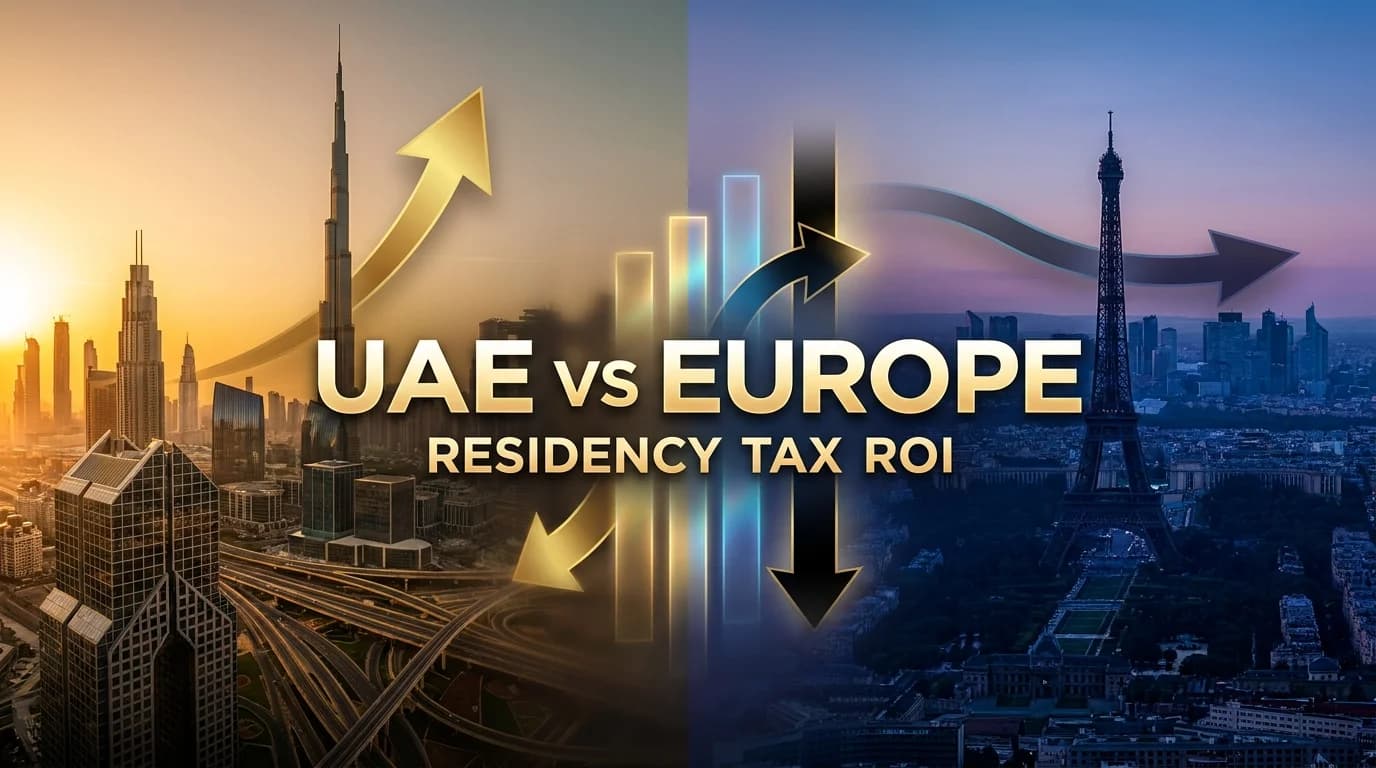
For the global citizen, the question is no longer where to live, but where to be resident. The choice between the UAE and Europe is not just a lifestyle preference; it is a high-stakes mathematical decision.
When comparing Return on Investment (ROI), the sophisticated investor does not look at the cost of the visa—they look at the "Leakage." Leakage is the percentage of wealth lost to taxation, regulatory friction, and inflation. In a world of 5% inflation and 40% tax brackets, "leakage" is the difference between a fortune that lasts three generations and one that vanishes in one.
This guide provides a comparative ROI analysis between the "Zero-Leakage" model of the UAE and the "Access-and-Legacy" model of European residency.
The UAE Proposition: The "Zero-Leakage" Wealth Accelerator

The UAE proposition — accelerated wealth compounding via 0% personal tax
The UAE has meticulously designed its residency system to attract the world's most productive capital. For the individual, the UAE is effectively a "Wealth Accelerator."
The Mathematics of 0%
The core of the UAE's ROI is the absence of personal income tax. If an investor generates $10 million in annual gains:
- In a high-tax European jurisdiction (e.g., France or Spain): After taxes, the investor might keep $5 million.
- In the UAE: The investor keeps $10 million.
This is not just "saving money"; it is compounding. The ability to reinvest the 40-50% that would have gone to a European government allows a portfolio to grow exponentially faster. Over a decade, this creates a divergence in net worth that can reach hundreds of millions of dollars.
The Specifics of the UAE Tax Regime
It is critical to distinguish between corporate and personal tax:
- Personal Income Tax: 0%. Whether you are a consultant, a trader, or a CEO, your salary and personal earnings are untaxed.
- Capital Gains Tax: 0%. Selling a company, a piece of Dubai real estate, or a cryptocurrency portfolio triggers zero tax liability for the individual.
- Corporate Tax: The UAE introduced a 9% corporate tax on profits above 375,000 AED. While this affects businesses, the personal wealth of the owner remains protected from the traditional "tax drag" seen in the West.
The Strategic ROI Drivers
- Time Zone Advantage: Dubai sits at the center of the world, allowing HNIs to manage assets in Asia and Europe within the same business day.
- Regulatory Speed: The "Can-Do" attitude of the UAE government means that corporate structures and visas are processed in days, not months.
The European Proposition: The "Access and Legacy" Model

European residency — tradition, mobility, but heavy tax leakage
European residency (via Golden Visas in Greece, Spain, Portugal, or Italy) offers a different kind of ROI. It is not a financial ROI in terms of cash-on-cash, but a Strategic ROI in terms of access and security.
The ROI of Global Mobility (Schengen Access)
The primary driver for European residency is the Schengen Area. A residency permit in one EU country allows for seamless movement across 27 nations. For an HNI, this means:
- Lifestyle Flexibility: The ability to spend summers in the Alps and winters in the Mediterranean.
- Business Access: Direct access to the EU single market, which is one of the largest economic blocs in the world.
The "Plan B" Insurance Policy
In an era of geopolitical volatility, a European residency acts as a hedge. It is "Wealth Insurance." Having a legal right to reside in a stable, democratic, and developed region of the world provides a level of psychological security that a purely financial ROI cannot quantify.
The Trade-off: The Cost of Admission
The "cost" of European residency is not the real estate investment (which is often 250k to 500k EUR); it is the Tax Leakage. Many European countries have:
- Wealth Taxes: Annual taxes on the total value of your assets.
- High Income Tax: Brackets that can reach 45% to 55%.
- Inheritance Taxes: Heavy taxes on the transfer of wealth to the next generation.
The ROI Comparison Matrix: UAE vs. Europe
| Factor | UAE Residency | European Residency (Schengen) |
|---|---|---|
| Personal Income Tax | 0% | High (Often 30% - 50%) |
| Capital Gains Tax | 0% | Moderate to High |
| Wealth Tax | None | Present in several EU nations |
| Wealth Compounding | Accelerated (Maximized) | Slower (Tax-dragged) |
| Global Mobility | High (Visa-based) | Very High (EU Freedom) |
| Political Stability | High (Stable Monarchy) | High (Democratic Institutions) |
| Ease of Setup | Very Fast | Moderate to Slow |
| Long-term Legacy | Fast Accumulation | Cultural Integration |
The "Hybrid Strategy": The Billionaire's Playbook

The hybrid strategy — UAE tax residency anchored by an EU safety valve
The most sophisticated HNIs do not choose one; they diversify their residency. Choosing only one is a strategic mistake. The "Billionaire's Playbook" involves a multi-jurisdictional approach to balance growth and security.
The Optimal Architecture:
- tax residency advisory in the UAE: This is where the "work" happens. The individual spends the required time (typically 183 days or as per the specific visa rules) in the UAE to maintain tax residency, ensuring that the bulk of their global income is not taxed.
- Residency/Passport in Europe: The investor maintains a European residency (e.g., via Portugal or Greece) as a "Safety Valve." This provides the family with the right to enter and reside in the EU without needing to be a "Tax Resident" there.
- Asset Holding in DIFC/ADGM: The wealth is not held in a personal name but within a DIFC Foundation or a holding company. This separates the person (who has the residency) from the assets (which have the legal protection).
Example Scenario:
An investor earns $50M/year from global tech ventures.
- Scenario A (Only Europe): After taxes, they keep $25M. They have a great lifestyle and EU access.
- Scenario B (Only UAE): They keep $50M. They have massive growth but no EU "Plan B."
- Scenario C (Hybrid): They keep $50M (by being UAE tax resident) and maintain a European residency for travel and security. This is the maximum ROI strategy.
Critical Risk Analysis: The "Tax Residency Conflict"
The biggest danger in a hybrid strategy is the Tax Residency Conflict. If an investor spends too much time in Europe, the European government may claim they are a tax resident there, regardless of their UAE status.
Key Risks include:
- The 183-Day Rule: Many countries claim you as a resident if you spend more than half a year there.
- Center of Vital Interests: If your children go to school in Europe and your main home is there, a tax authority may argue that Europe is your "center of vital interests," even if you spend 200 days in Dubai.
- CFC Rules (Controlled Foreign Companies): Some European nations tax the income of offshore companies if they are managed from within the EU.
To mitigate this, UHNWIs must employ a rigorous "Day Counting" system and maintain a clear legal separation between their business operations and their personal residences.
FAQ
Which is better for wealth preservation: UAE or Europe?
For pure wealth preservation and acceleration, the UAE is superior due to its 0% personal income and capital gains tax. However, for geopolitical diversification and mobility, European residency is a vital strategic hedge.
Does the UAE have a corporate tax?
Yes, the UAE has a 9% corporate tax on business profits exceeding 375,000 AED. However, it is crucial to note that there is no personal income tax and no capital gains tax for individuals.
Can I be a tax resident of the UAE while holding a European Golden Visa?
Yes, but you must be careful. To avoid paying taxes in Europe, you must ensure you do not trigger the "Tax Residency" rules of that European country (e.g., by staying under the 183-day limit and not making it your primary center of life).
Which European residency is the most tax-efficient?
This depends on the specific program. Some countries offer "Non-Habitual Resident" (NHR) schemes or special tax regimes for the first 10 years, but these are constantly changing. Professional tax auditing is required to choose the right one.
What is the ROI of a UAE residency compared to a European one?
The ROI of UAE residency is primarily financial (maximized capital compounding via 0% tax). The ROI of European residency is primarily strategic (EU market access, travel freedom, and geopolitical security).
Final Strategic Verdict
The decision between the UAE and Europe is not a binary choice; it is a balance of Growth vs. Security.
If your goal is to aggressively grow your net worth, scale a business, and minimize leakage, the UAE is the undisputed winner. If your goal is to secure a "Plan B" for your family and gain access to the European continent, a European residency is an essential asset.
The ultimate ROI is achieved by the Hybrid Model: Accumulate in the UAE, diversify in Europe, and protect everything via the DIFC.

Muhammad Zohaib
Founder & CEO of Early Bird Properties with 13+ years of Dubai real estate experience. RERA certified.