
Dubai Rental Index: All You Need to Know before Leasing

Introduction
Planning a move to Dubai or changing flats in the offing? You may find yourself dealing with one of the first things that come your way is the Dubai Rental Index. As a fresh face to flat leasing in Dubai, even the idea of rental legislation, pricing rules, and RERA regulation can be overwhelming.
But here's the best part: the Dubai Rental Index was established to safeguard landlords and tenants. It keeps everything level, forestalls mad increases, and lets you find out what Dubai rents are like before you commit to a contract.
We're going to spell it all out for you in this guide so you're totally informed about what to do before renting in Dubai.
What is the Dubai Rental Index?
The Dubai Rental Index is a sanctioned index developed by the Real Estate Regulatory Agency (RERA). It provides benchmarks for rental rates of various sizes of properties, positions, and types of properties within Dubai.
Imagine it as a reference that informs you of a Business Bay studio or a Dubai Marina 2-bedroom's fair rent. Landlord or tenant, the RERA rental index Dubai serves as a reference for rent renewals and contracts.
Why Was the Dubai Rental Index Introduced?
Let’s be honest: without rules, landlords could raise rents however they like, and tenants would constantly worry about affordability. Dubai wanted to prevent this.
The index was introduced to:
- Protect tenants from unfair rent increases
- Give landlords a structured way to adjust rent
- Create transparency in the Dubai housing market
- Standardize rents across neighborhoods
So, whether you’re renting a cozy studio or a luxury villa, the index keeps things fair for everyone.
How does the Dubai Rental Index Functions?
At the time of your tenancy renewal, your landlord will only be able to raise rent based on standards in the rental index.
Here is how it generally works:
- If your rent is at or near the average rent in Dubai for comparable units, No rent hike.
- If your rent is below market average, the landlord may raise it by a small percentage.
- If your rent is far below the market rate, the landlord can raise rent by a larger proportion (still within law).
You can actually compare your Dubai apartment rent online using the RERA calculator
before negotiating with your landlord.
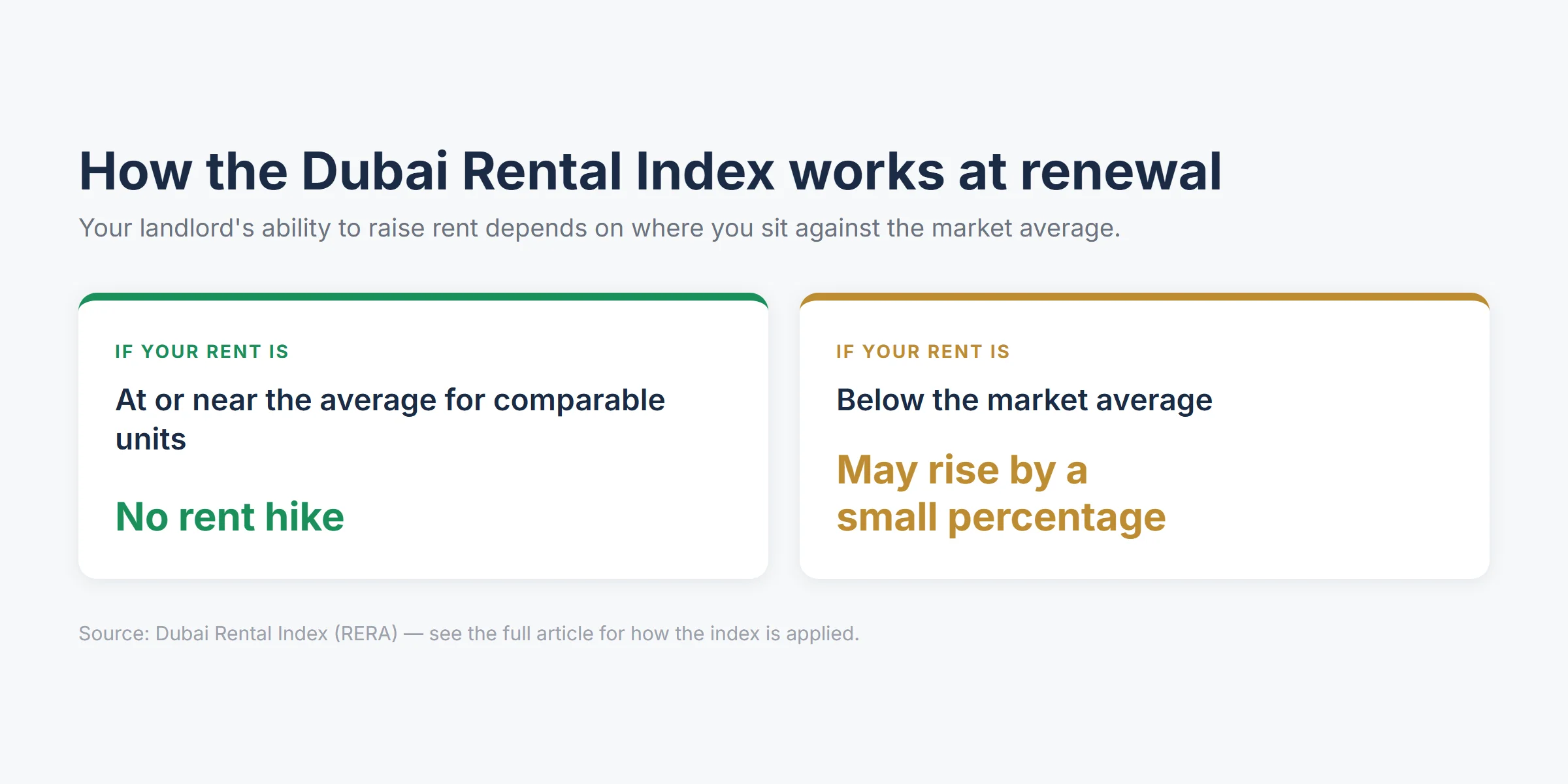
How the Dubai Rental Index applies at renewal.
Important Things to Know Before Renting in Dubai
1. Rules on Tenancy Contract
All rental contracts need to be registered on Ejari (the official RERA tenancy contract system). This legally binds your contract and secures your rights in case there is a conflict.
2. Dubai Rental Increase Law
Dubai rent law restricts the amount by which rent can increase by landlords. Under Decree No. 43 of 2013 the permitted increase runs from no increase at all up to 20%, depending on how far below the average market rental rate your current rent sits.
Example
If you’re paying AED 50,000 for a 1-bedroom in JLT and the market average is AED 55,000, your landlord may only increase slightly, not hike it to AED 70,000.
3. Average Rent in Dubai (2025 Snapshot)
Here’s a quick Dubai property rental guide with ballpark figures (these vary by location, but the index helps keep them regulated):
- Studio apartments: AED 35,000 – 55,000/year
- 1-bedroom apartments: AED 50,000 – 90,000/year
- 2-bedroom apartments: AED 75,000 – AED 150,000/year
- Villas: AED 120,000 – AED 300,000+/year
It will save you from overpaying if you check Dubai's average rent before signing.
4. Security Deposit & Rent Payments
- Security deposit: typically 5% of annual rent (unfurnished) or 10% (furnished).
- Rent payments: usually in 1–4 installments with post-dated checks.
Benefits of the Dubai Rental Index for Tenants
- No surprise rent increases
- Transparent pricing upon rent in Dubai
- Legal recourse through RERA and Ejari
- Safety while budgeting for a house
It's just as useful for landlords renting out a Dubai apartment as well. They have something to point to in order to justify hikes without driving tenants out.
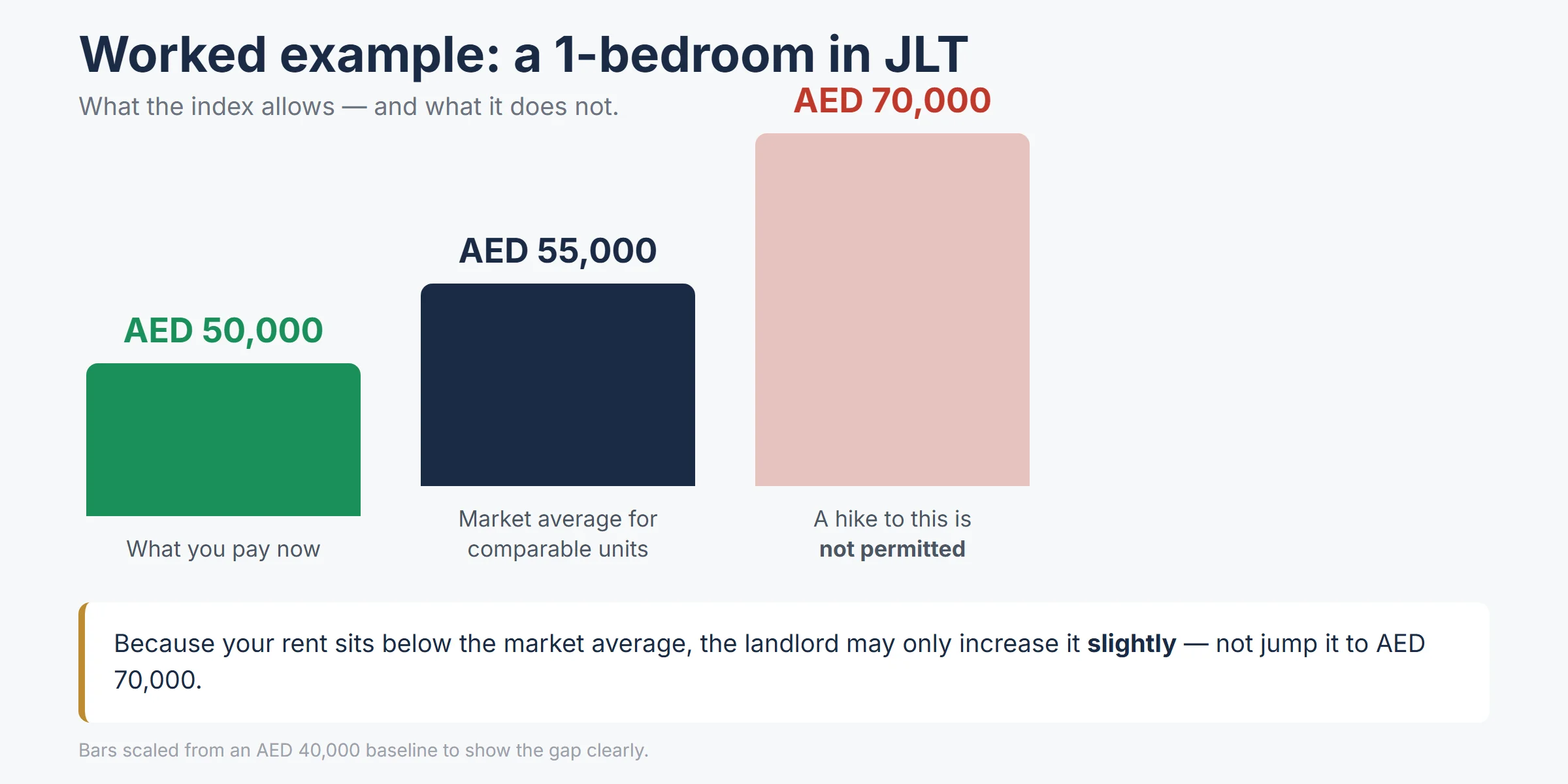
The article's JLT example, visualised.
Not sure if your rent increase is legal? Ask us — free, no pitch
Tips for Tenants: Making the Most of the Dubai Rental Index
- Reference the RERA calculator upon signing or lease renewal.
- Bargain wisely if your landlord proposes an increase above the cap, produce the index to demonstrate.
- Know your tenancy rights in Dubai you cannot be evicted without cause.
- Weighing up the surrounding districts the index allows you to balance whether it is worth paying more for proximity benefits such as metro links or sea views.
- If your renewal figure is close to what a mortgage payment would be, our rent vs own in Dubai guide puts the two monthly numbers side by side.
Conclusion
Renting in Dubai doesn't have to be scary. The Dubai Rental Index is your buddy when it comes to reasonable prices, legal recourse, and peace of mind.
Before you sign on the line, spend a few minutes scanning the index. It could save you thousands of dirhams (and a lot of anxiety).
If you're renting your first home in Dubai or moving into a larger property, take this tip to heart: the more comfortable you are with the system, the greater the choice of rent will be.
FAQs
1. Can my landlord raise rent at any time?
No, your landlord cannot increase rent anytime they wish. According to the Dubai Rental Index and Dubai tenancy laws, rent can only be increased during the renewal of your tenancy contract, not in the middle of the agreement. Even then, the increase must strictly follow the limits set in the Dubai rental increase law. So, if you’re worried about sudden hikes, the law has your back.
2. How frequently is the Dubai Rental Index updated?
The Dubai RERA rental index is typically revised each year to show change in the real estate Dubai market. Such a revision maintains the average rents the index shows as realistic and acceptable with the existing market conditions. Consultation of the index when your tenancy agreement is up for renewal every year is recommended so that you may verify if your landlord can raise rent or not.
3. What if I believe that my rent is excessive or greater than the index?
If your landlord is demanding higher rent than the Dubai apartment rent index suggests, you can object. You can:
- Present your landlord with the official RERA calculator print-out.
- If this fails to resolve the matter, report your issue to the Dubai Rent Dispute Settlement Center.
- Your case will be heard and the RERA tenancy contract system will be taken into consideration as evidence to come to a just judgment.
4. Is the Dubai Rental Index comprehensive, all-encompassing for all areas and property types?
Yes. The Dubai Rental Index includes flats, villas, and townhouses across a number of neighborhoods. Whether you're looking at a studio flat in International City or a penthouse flat in Downtown, the index provides you with a yardstick for reasonable prices. Keep in mind, however, that a few of the more sought-after areas (such as Dubai Marina or Palm Jumeirah) might be slightly more expensive but they have to stay within what the index dictates.
5. What can I do with the Dubai Rental Index as a tenant?
The Dubai Rental Index isn't only for landlords, it's valuable for tenants as well. When you're ready to negotiate a new lease or renewing one, simply refer to the index through the RERA online calculator. If your landlord tries to raise the rent over permitted levels, you can deal confidently using the official figures at hand. It also assists you in comparing various locations, identifying a good bargain, and paying less than you should. Basically, the index assists you in utilizing the information with which you can wisely rent a place in Dubai.
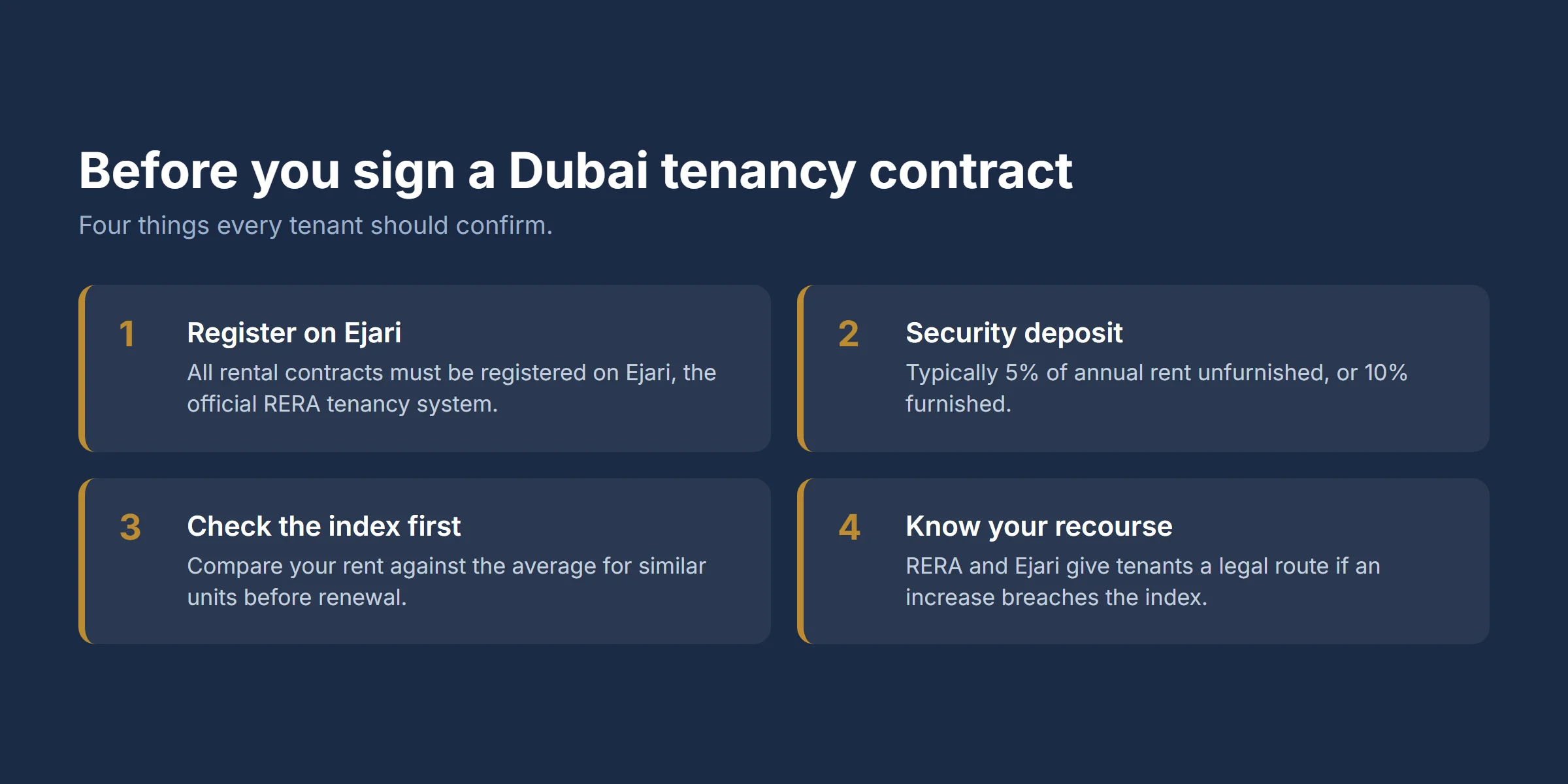
Four things to confirm before you sign.
Check it yourself: the official government sources
Everything above comes from Dubai government sources. Go to them directly — they are the authority. The rental index and its calculator are free to use; the Ejari registration below carries a government fee.
- Dubai Land Department — Rental Index: the official calculator. Enter your contract date, property type, area and current rent to see the average market rental and the increase permitted on renewal. It is free to use.
- Register or renew an Ejari tenancy contract: DLD lists the total as AED 177.75 through the Dubai REST app or the DLD website (AED 100 registration, AED 10 knowledge fee, AED 10 innovation fee, AED 55 service partner fee and AED 2.75 VAT), or AED 220 through a trustee centre.
- Rental Disputes Center: where a landlord or tenant files a case when the two sides cannot agree.
The bands that apply at renewal, from Decree No. 43 of 2013
Article 1 of the decree sets the maximum increase on renewal by how far the current rent sits below the average market rental rate:
- No increase — where the rent is less than 10% below the average market rental rate.
- 5% — where the rent is 11% to 20% below.
- 10% — where the rent is 21% to 30% below.
- 15% — where the rent is 31% to 40% below.
- 20% — where the rent is more than 40% below.
Note the first band: where the rent is already close to the market rate, the decree permits no increase at all. Article 3 states that the average market rental rate is set according to the Rent Index of the Emirate of Dubai, approved by the Real Estate Regulatory Agency. Article 2 applies the decree to all landlords of the public and private authorities in Dubai, including the special development areas and the free zones, and including the Dubai International Financial Centre. Because Article 1 is written around renewing a lease, these caps govern renewals rather than the rent first agreed on a brand-new tenancy. The full text is on the Dubai Government Legislation portal.
On notice, one detail is usually stated too simply. Article 14 of Law No. 33 of 2008 reads in full: "Unless otherwise agreed by the parties to a Lease Contract, where either party wishes to amend any of its terms pursuant to Article (13) of this Law, that party must notify the other party of this intent no less than ninety (90) days before the date on which the Lease Contract expires." Two things follow. Ninety days is the default and the parties may agree a different period in the contract itself, and the article covers amending any term of the lease, not rent alone. Read your own tenancy contract before assuming the default applies to you.
Fees and procedures above are as published by the Dubai Land Department, the Rental Disputes Center and the Dubai Government Legislation portal, checked on 12 August 2026. Government fees and services change — confirm the current position on the official pages linked above before acting on them. This article explains how the official system works; it is not legal advice.
Frequently Asked Questions
Is Dubai good for property investment in 2026?
Yes. Dubai offers 6-8% rental yields, zero income tax, strong appreciation, and 100,000+ annual population growth. Q1 2026 saw record AED 108B in transactions.
Can foreigners buy property in Dubai?
Yes. Foreigners can buy freehold property in designated areas with no restrictions. Popular zones include Downtown, Marina, JVC, Palm Jumeirah.
What is minimum investment for Dubai property?
Studios start from AED 400K in JVC and Sports City. Golden Visa requires AED 2M minimum. Off-plan offers 10-20% down payment plans.
What are the best areas to invest?
For yields: JVC (7.5%), Silicon Oasis (8.2%). For growth: Dubai Hills (+18%), Business Bay (+15%). For luxury: Palm Jumeirah, branded residences.
Is there tax on rental income in Dubai?
No. Dubai has zero income tax and no capital gains tax. Investors retain 100% of rental income and profits.
Off-plan or ready - which is better?
Off-plan offers 15-25% lower prices but delays income 2-3 years. Ready provides immediate rental. Choose based on your income vs growth priority.
Talk to a licensed Dubai broker about your tenancy — free, no pitch